It’s been a couple months since I’ve posted last. Philosophy/literature post coming on Saturday. Here’s an update.
Hiya. It’s been a minute. I haven’t posted in a couple months so I figured I’d catch ya’ll up on what’s happening in my life. Plus, any excuse to write is a good one. So here y’are.
I typically go through cycles of which hobbies I pursue, and which ones I don’t. My blog has been one that just hasn’t been on the plate the past couple months. So that’s why I haven’t been writing. Until now, of course.
Nothing crazy or interesting has been going on. Life’s just been life—ebbing and flowing. Good things, bad things.
I should probably do better to maintain my relationships with friends and family—I often neglect them. You should call yours. I should call mine.
I probably won’t.
Anyways, on the brighter side, in my alone time I’ve been proudly consistent in pursuing my hobbies. Some for shits, some for giggles. Some for neither shits, nor giggles.
I’ve got music coming up—a solo project that I’ve been putting a lot of effort into since Election Day. You’re the first to hear about it. It’s an instrumental maidcore, post-rock, experimental-pop project—if any of those terms mean anything to you. Primarily lead by guitars. It’s been an absolute joy to make.
There are more field recordings coming up as well—one that I should have released back in October, and a few newer ones. Expect those.
A field recording location. Susquehanna River (not depicted).
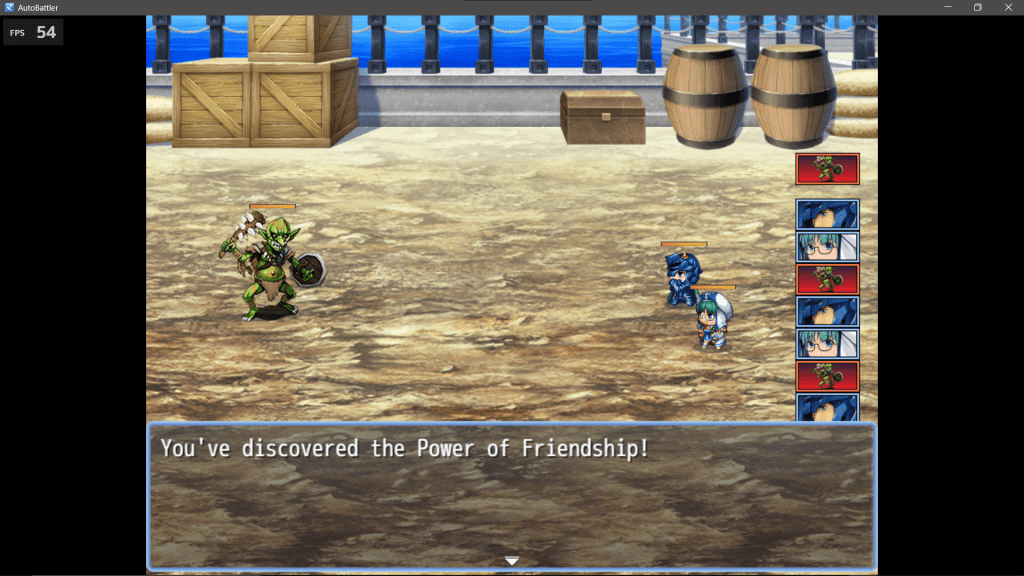
I’ve started dabbling in game development, dipping my toes into RPG Maker MZ. My hope is to complete a demo and playtest it with my friends. There’s still a lot to be done, though, and follow-through is sometimes a coinflip.
“AutoBattler” – an RPG Maker MZ demo project.
I’ve also worked on some Microsoft Excel projects.
One’s a sheet that helped me ween off of my medication (nothing crazy, tricyclic antidepressant for migraines).
Another is a sheet that essentially simulates the turn-based combat that happens in my game demo, which has made game balancing a lot easier.
The last, that’s still in the works, is a financial tracker. I made one before, but I wanted this one to include more features. I may even write a post about it when it’s done, in case it could help someone.
I won’t bore you with pictures.
I’ve also been reading. I’ve finished a couple classics—1984 by George Orwell and East of Eden by John Steinbeck.
I’ve finished some not-so-classics, but fun fantasies—Tigana by Guy Gavriel Kay and Ruination by Anthony Reynolds. Yes, the League of Legends novel. I’m a nerd, what else is new.
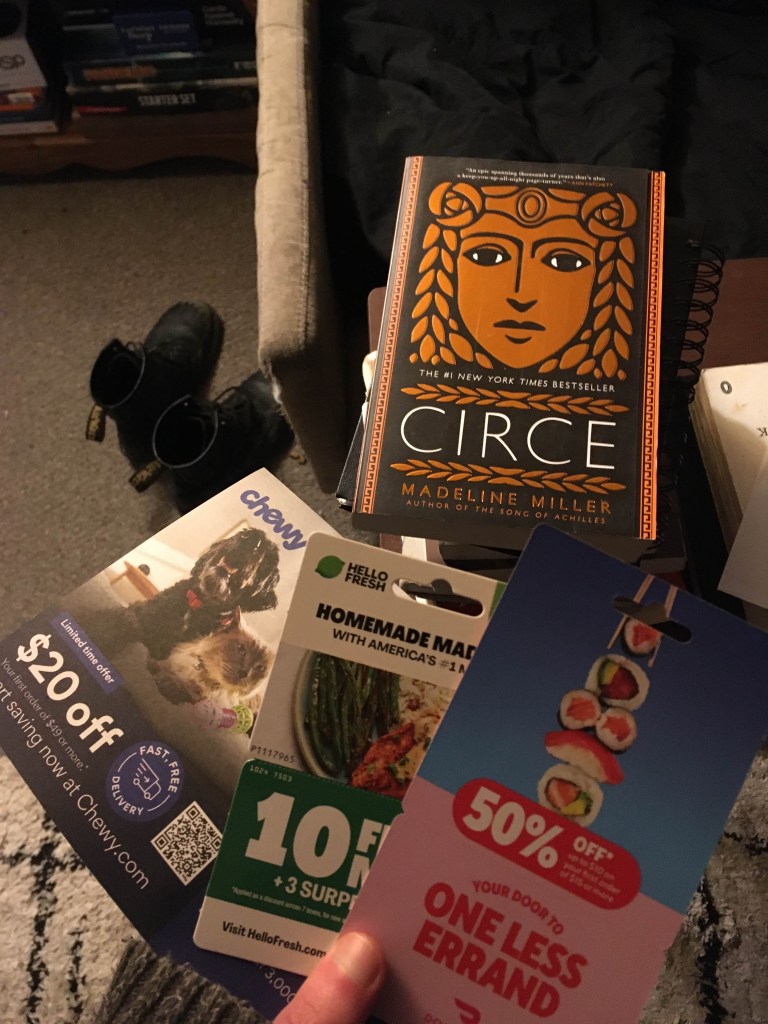
I’m currently reading Circe by Madeline Miller. So good.
Circe by Madeline Miller, along with some neat deals I got from Thriftbooks. I haven’t used them.
I’ve went on some hikes.
A recent hike. Susquehanna River. (Not depicted, this is just a big rock.)
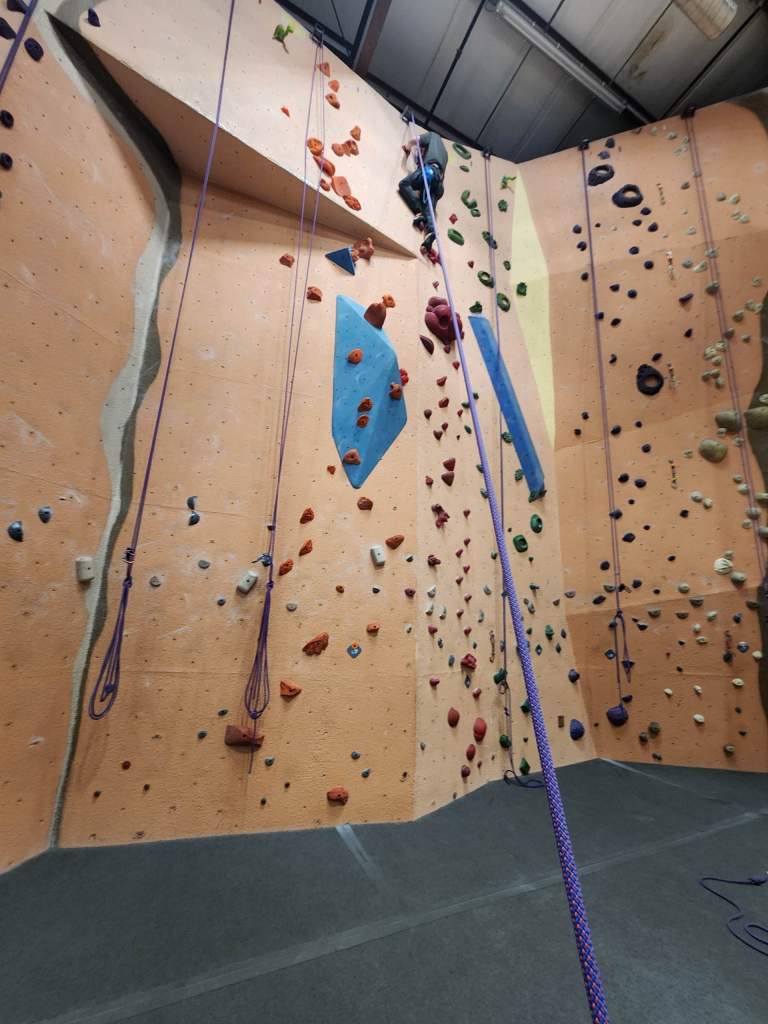
Went to the climbing gym with my brother.
Pissing and shitting at the climbing gym.
So yeah. Not much else has changed. I’d like to think I’ve grown some—there’s always something to come to terms with, something to do differently. It’s sometimes exciting to be challenged in that way.
Most importantly, and as always, I am incredibly grateful. For friends, family, cats—you (the reader). And for all of the things I enjoy.
How do you quantize drums while maintaining the “human quality?” Without getting rid of the “feel?” This is a hotly debated topic among musicians, producers, engineers. Myself, I have a loose, open-ended solution that you can apply to any and all songs that you work on.
One of the most devastating questions I’ve ever received was after showing a respected artist my then-band’s new single – “do you program your drums?” I record my drums with an electronic drum kit, and quantized them very close to perfectly on-grid.
I wanted to re-record drums entirely to fix this problem, but we had already been sitting on the single for a little bit, and my bandmates were eager to release, so we put it out. As a perfectionist, it took a lot for me to willingly overlook the robotic drums on that track and continue with the release.
Oh, you can listen to this song on YouTube and Spotify, too.
I’ve developed a formula, workflow, whatever – that you can use when you’re quantizing any drum track.
How to Quantize Drums
Open your project file in your DAW of choice. Let’s take a look at the drums. Do whatever you have to do to hone in on them.
Since I typically work with MIDI, it’s a tad easier for me. But I’ll cover what I do when I’m working with recordings, as well.
Categorize the Drum Kit
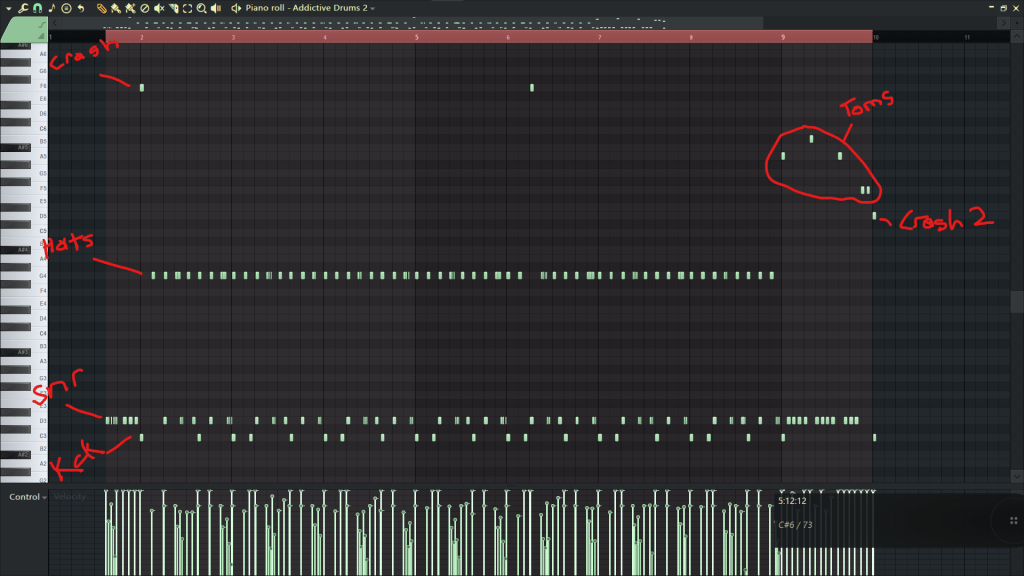
Locate the following tracks or MIDI notes:
Kick
Snare
Cymbals
Toms
Whatever else – overheads, rooms, other percussion.
When you’re familiar with your drum tracks, we can start conceptualizing what we should do to them.
Serving the Song – Settling the Debate
Some people quantize directly on-grid. Some people say you lose the human quality when you do that. So, what are we supposed to do?
You’re going to quantize sometimes on-grid, and sometimes off-grid, but in such a way that serves the song. This means know when and when not-to. You can also apply this concept creatively – leave me here to discuss the rest while you choose how and when to quantize on and off-grid.
We go more in-depth a few subheadings ahead. For now, have these three concepts in mind: groove, emphasis, and fills.
Quantize Simultaneously When Possible
Our paths diverge, slightly some, if you are working with audio instead of midi. This next rule especially applies to audio – it’s also a beneficial concept if you’re also working with MIDI, but if you are, you can apply this rule less strictly.
When you’re moving beats around on the grid – make sure you’re moving all of the drum audio tracks together, when you’re moving things around. If you don’t, you’ll run into alignment issues with each drum track – things will be off and potentially out of phase.
This is also the way to most effectively preserve the “character” of the drummer – their timings, or groove, is most accurately preserved by moving a bulk of notes/tracks, rather than individual ones. This is why it can also benefit people working with MIDI.
Start with Kick and Snare
We’ll start, together, with our kicks and our snares.
Take it in chunks – measure-by-measure
Drum quantizing can be a long, daunting process. This is why I personally opt to do so measure-by-measure – breaking down the track into small segments of audio that I can punch through one-by-one.
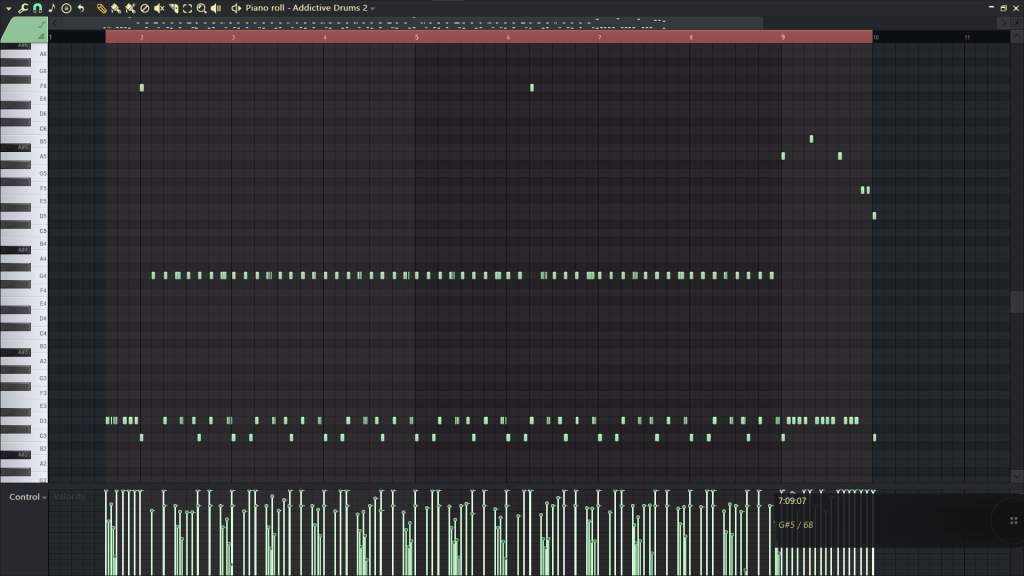
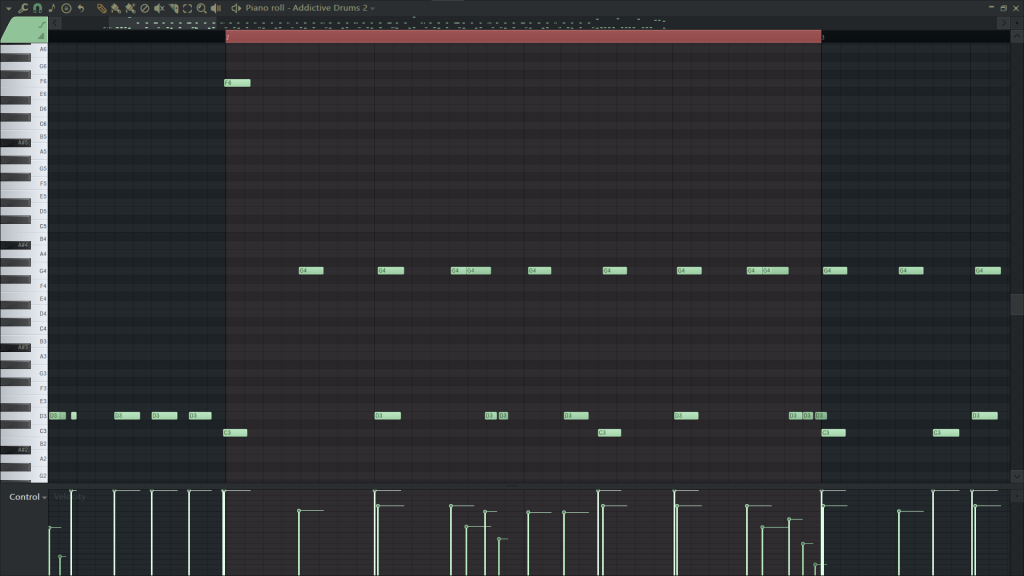
In FL Studio, I do this by highlighting only the specific measure I’m currently working on.
Now, remember the three concepts I asked you to remember: groove, emphasis, and fills.
Does it groove?
Looking at both our kick and our snare, we ask ourselves “does it groove?”
Groove can be summed up by the micro-timings of particular drum hits. If the drum track is playing multiple notes in a measure, consecutively and often, then it contributes groove.
Looking at our kick and snare, we see that our kick is played rarely – but our snare is quite busy. This means that the kick does not groove, but our snare does.
If it grooves – maintain the earliness or lateness of the notes. Do not move them directly on-grid, but closer to the grid than they were before, while keeping sure that they are still early or late.
The amount of distance you put between the note and the grid is up to you at this point. Find what serves the song – typically, I would make sure there is a slightly moderate distance.
Remember, closer to the grid typically means beat emphasis, such as:
Does it emphasize?
We’ve found that our snare grooves, but what about our kick?
Here we’re looking for notes that emphasize particular beats of the song as a whole. These notes are typically a lot fewer, or more scarce.
That is the case with my kick, as it only has two beats in the measure.
You can also pay attention to the song as a whole to help decipher whether or not a specific note emphasizes a particular beat of the song.
If you determine that a note emphasizes, instead of grooves, you want the transient of that note directly in-line with the rhythm of the other instruments.
Since I quantize my other instruments pretty on-grid, this looks like moving the note directly, immediately, on-grid. This may not be the case for your song, so keep that in mind. Align the transient of the kick to the rest of the song.
Does it fill?
Fills exist as kind their own thing, compared to the beat. Since they typically take up a shorter amount of measures, it’s helpful to conceptualize them on their own.
To do this – we just maintain the earlier concepts of groove and emphasis.
Is there a crash hit on an emphasized beat? That’s emphasis. Keep it as on beat as possible.
Is there a fast tom fill? Since it’s a lot of consecutive notes, it grooves. Move them closer to grid, but not entirely on it – maintaining the early/lateness of the drummers performance.
Repeat with the other drum categories
We lead this exercise with just the kick and snare, so that it’d be less overwhelming to tackle. But you will have to go through the same process of deciding if it grooves or emphasizes with each drum, from our earlier list above.
If you’ve been following along – listen to your before and after, if possible. It will almost certainly serve the song well.
Closing
Quantizing drums and maintaining the human feel is a hot topic. The great thing about debates, is we get to decide our own opinions and feelings.
If you’re new – do not feel that your creative decisions are worth less than someone who’s more established.
Have bold ideas – and pursue them, even if you second guess yourself. If you disagree with how I quantize drums – tell me why! Let me know how you would do things, even if you’re new!
However you decide to quantize, these guidelines will set you up for success – but if you have ideas of how you might want to do things differently, pursue those at all costs.




 Jake Gibson - Musician, Writer, and Hobbyist.