Opening
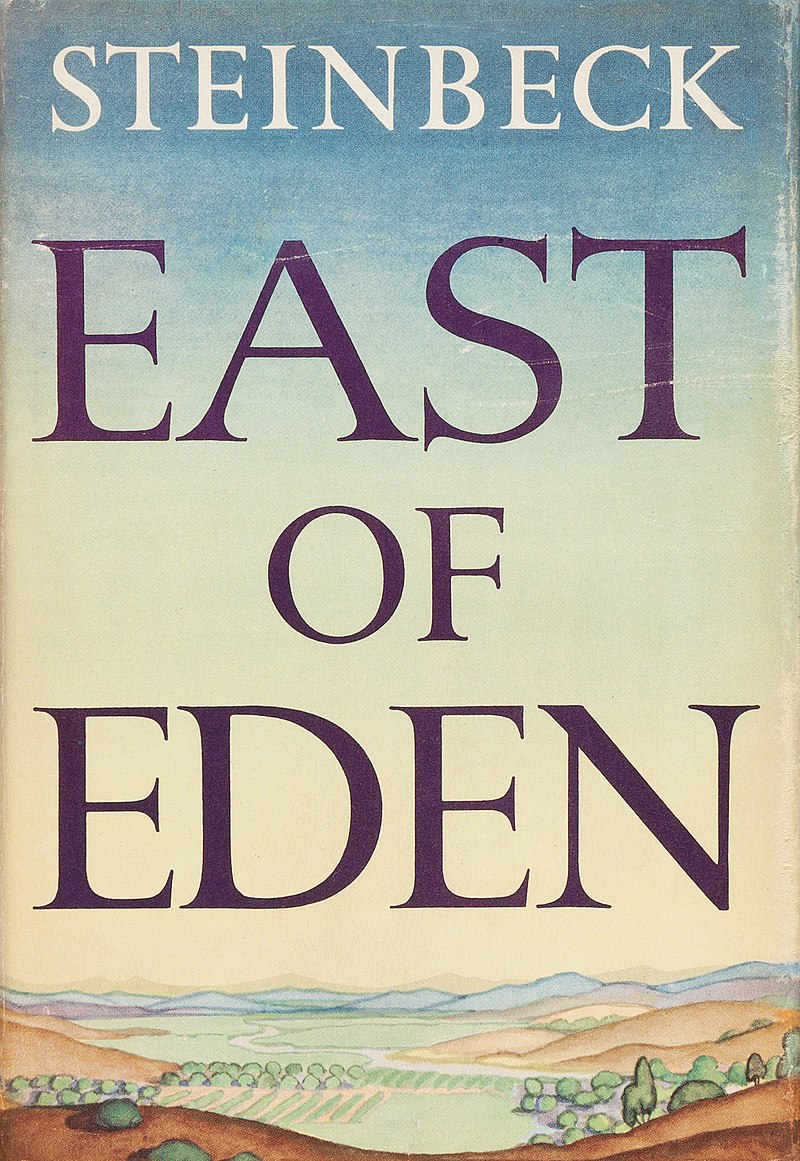
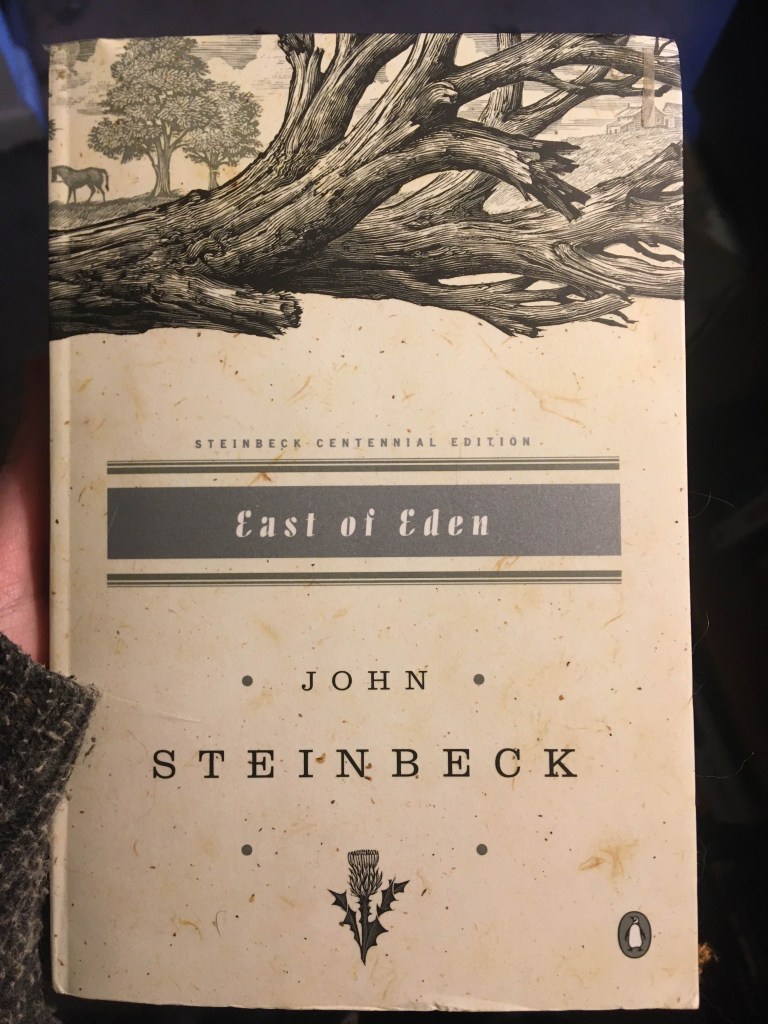
I’ve recently finished East of Eden by John Steinbeck. This book has tapped a powerful, loving, human source in me. I’ve had a million thoughts and came away feeling my humanity in my gut.
I’ll be attempting to organize and present my thoughts. Expect spoilers, but don’t let that dissuade you from reading and engaging in the larger philosophical discussion.
I would enjoy hearing thoughts that aren’t my own—even disagreements.
Consider commenting.
- Opening
- Background
- Cain, Abel, and “the basis of all human neurosis.”
- Timshel (thou mayest).
- About Choice (Summarization)
- The richness of life.
- Book moments
- Conclusion
Background
Before I begin, a bit of background.
Firstly, I am no expert reader. Truthfully speaking, I’ve only completed books within the last couple of years, despite having a bookshelf that might suggest otherwise. I do not claim to have any authority as if I’ve studied literature, or anything else. I’m just a human who is simply presenting his thoughts.
Secondly, if you’re unfamiliar with East of Eden, it is a novel written by John Steinbeck. He’s the author of such classics as: Of Mice and Men and The Grapes of Wrath. Wikipedia presents East of Eden as John Steinbeck’s “most ambitious novel,” and that “Steinbeck himself considered it his magnum opus.”
I don’t know if I can do justice in introducing this book. I would instead suggest that if you’re unfamiliar, take a brief skim of the introductory paragraph on its Wikipedia page linked above, then return.
Or don’t. You can still engage without it.
Cain, Abel, and “the basis of all human neurosis.”
East of Eden deliberately parallels the story of Cain and Abel from the Book of Genesis in the Bible.
If you’re unfamiliar with the story, a quick synopsis:
Cain and Abel are brothers, both sons of Adam (Yes, Garden of Eden Adam). They each presented a sacrifice to God. God held grace for Abel’s sacrifice, but not for Cain’s. Cain grew jealous of God’s favor to Abel and murdered his brother. Cain was then cursed and marked by God.
In East of Eden, there are two sets of characters that represent Cain and Abel. You can identify their representations by their first initial.
In the opening part of the book, it is Charles and Adam Trask, sons of Cyrus Trask (who symbolizes God.) Later on, it is Adam’s sons, Cal and Aron Trask, that represent Cain and Abel respectively.
Thus, the story of Cain and Abel plays out twice within the novel – but each instance has its differences.
In the first, Charles does not kill Adam as Cain kills Abel. He intends to, but Adam escapes.
In the second, Cal inadvertently kills Aron by showing him the truth of their, otherwise thought dead, mother (a psychopathic brothel-keeper.) An action that Cal knows will destroy Aron. Aron breaks down, enlists in the army, and dies in World War 1.

“The basis of all human neurosis.”
Steinbeck is quoted as saying, “…this one story [the story of Cain and Abel] is the basis of all human neurosis—and if you take the fall along with it, you have the total of the psychic troubles that can happen to a human.”
This is more of a poetic statement than a scientific one. A simple story cannot “be the basis for all human neurosis,” but it presents an interesting theme that I’ve found present in my own life, and would bet large sums that it is in yours as well.
Sometimes, typically in reaction to unfairness, we can feel jealousy, anger, or even hatred. These feelings can even make us think about doing something cruel to someone.
A selfish thought—but a human one.
I believe this is what Steinbeck is referring to when he says “the basis of all human neurosis.” This thought, jealousy, feeling of neglect, may prompt bad things, “the fall”—it prompted Cain to slay his brother, Abel.
Okay so, yeah, bad feelings may prompt bad outcomes—but we’re not all murderers or doers of bad. So, what else?
Speaking from both my experience and what is presented in East of Eden, these jealous and neglected feelings don’t just have the potential to prompt bad action. They can simply prompt more feelings—shame and guilt for having ever thought or felt those cruel things at all.
This is something that is represented in what I feel is the ultimate protagonist of the book, Cal Trask. More on him later.
What I think Steinbeck is ultimately saying is that—in Cain’s experience and humanity’s similar experiences, there exists potential for bad thoughts and feelings. As a result of them, we may hurt people—or, in those of us who acknowledge that it is wrong to do so, we may self-indulge in shame, guilt, and self-pity. “Taking the fall” into either, we experience internal anguish.
But those are only potential outcomes.
Timshel (thou mayest).
Timshel/Timshol mistranslation, and my reconciliation.
Before moving on, there is an important controversy to acknowledge.
About halfway through the book, there is a discussion on the story of Cain and Abel by Lee, Samuel Hamilton—both of which are the heart and soul of the book, along with others—and Adam Trask, in which the various translations of the original Hebrew text are called into question.
Lee lands on the epiphany that a Hebrew word from the story, timshel, means “a choice,” rather than a command, and this becomes a central theme of the book and plays heavily at the story’s end.
Except, the Hebrew word timshel isn’t the word used in the story of Cain and Abel—it’s actually the word timshol, which apparently does imply a command (or governance, properly, I believe.)
This article is a great read on the topic. You can also find other sources, as well.
This certainly is a hole in the story. However, I don’t believe that this mistake (or whatever it may be) necessarily detracts from the story’s main theme: choice.
My reconciliation is this: the theme of choice remains intact, so long as you are willing to set aside the oversight.
I might keep this in mind if you were considering getting a timshel tattoo, however, like I was.
The idea of choice.
This is a quote from the aforementioned discussion about halfway through the book.
The King James translation makes a promise in ‘Thou shalt,’ meaning that men will surely triumph over sin. But the Hebrew word timshel—’Thou mayest’—that gives a choice. For if ‘Thou mayest’—it is also true that ‘Thou mayest not.”
This references God’s conversation with Cain after he slew Abel.
Thou mayest triumph over sin. This is the central theme of East of Eden—that choice exists.
When we look at this in the context of the Cain and Abel story, or even Cal and Aron’s story, we see that Cain chose to slay his brother. He felt these difficult feelings which prompted a decision—and he chose badly.
To put it conceptually, I think of it this way. God did not acknowledge Cain’s sacrifice as he did Abel’s. This sparked bad feelings and thoughts from within Cain. When these were sparked, a choice is had between what I would conceptualize as three different options (there may be more or less), presented in East of Eden:
- Cain’s chosen path—slay your brother. Act badly, hurt someone, do something evil or wrong.
- Wallow—marinate yourself in the guilt and shame you feel for having had these jealous, bad feelings and thoughts in the first place.
- Do not take the fall—do not act badly and do not wallow. Acknowledge that, as humans, we are imperfect beings who may think imperfect thoughts and have imperfect feelings.
Cal Trask and the Indulgence of Self-pity
Before I go on, I think it’s important to acknowledge that I am no authority on any matters of psychology. Though it is an enticing idea that this may be some kind of psychological solution—I am not a psychologist, nor have studied, nor do I make this claim. Have your thoughts, but be skeptical. Remember that this is just a human’s thoughts on a thought-provoking fiction book.
I want to talk about choice two, as it is explored with Cal Trask’s character and is the option I’ve suffered from most, personally. Let’s start with an excerpt from Chapter 51—a conversation between Lee and Cal as Cal is feeling down on himself after telling his brother Aron the truth about their mother (again, a psychopathic brothel-keeper) knowing that it would hurt him, which then caused Aron to break down and go missing:
“And are you taking pleasure from this whipping you’re giving yourself? Are you enjoying your despair?”
“Lee!”
“You’re pretty full of yourself. You’re marveling at the tragic spectacle of Caleb Trask—Caleb the magnificent, the unique. Caleb whose suffering should have its Homer. Did you ever think of yourself as a snot-nose kid—mean sometimes, incredibly generous sometimes? Dirty in your habits, and curiously pure in your mind. Maybe you have a little more energy than most, just energy, but outside of that you’re very like all the other snot-nose kids. Are you trying to attract dignity and tragedy to yourself because your mother was a whore? And if anything should have happened to your brother, will you be able to sneak for yourself the eminence of being a murderer, snot-nose?”
Cal turned slowly back to his desk. Lee watched him, holding his breath the way a doctor watches for the reaction to a hypodermic. Lee could see the reactions flaring through Cal—the rage at insult, the belligerence, and the hurt feelings following behind and out of that—just the beginning of relief.
In this case, Cal has technically chosen option one—he hurt his brother. Cal, after acting, feels the guilt and shame of doing so.
However, as adults practiced in self-control, I believe this excerpt also applies to option two—not guilt and shame for having done wrong, necessarily, but guilt and shame for having thought bad thoughts, or thought about doing wrong.
Here, is presented an idea that requires humility and acceptance—that wallowing in guilt and self-pity is self-absorbed and harmful.
The argument made here is that—when you wallow yourself in guilt, when you think yourself an evil character, then you are “marveling at your tragic spectacle.” You take, in some form, entertainment (or simply mental occupation) from the way you view yourself—as a guilty, villainous bad person. And, definitionally, that is self-absorbed—you choose to exist in a space in which you are the primary occupant of your thoughts.
The next prompted questions are—is that self-absorbed wallowing necessarily a bad thing? How do we know? Steinbeck would likely argue yes, as by entertaining such you are then “taking the fall into neurosis.”
I don’t presume to know the answer, it’s quite a big question. Maybe it’s better answered by a professional—unless tackling big questions is fun for you, as they are for me. I would have to take some time to deliberately think, though. My gut inclination is to agree with Steinbeck—arguing “no” would not be easy. So, for now, I’ll say yes, it is harmful—while keeping in mind that I’ve not thought about it thoroughly.
The idea that this wallowing is self-absorbed can be quite a brutal one. For someone like me, who is prone to guilt, even hearing the idea that I’m being self-absorbed… makes me feel guilty for being self-absorbed.
But, as we’ve learned, there is always a choice. You can entertain the marvelous, self-absorbed spectacle of your tragedy—or you can acknowledge such thinking as one of your innate, human imperfections.
Which leads me to perhaps my favorite quote in all of East of Eden, and what is the beginning of Cal’s relief in the excerpt above:
“Now that you don’t have to be perfect, you can be good.”
The idea that humans are imperfect as a unit presents something I’ve found incredibly cathartic—sometimes the thoughts and feelings we have are not perfect. We may, as the whole of humanity, think and feel bad things. It’s not that you are evil or different for it—it’s that you are human, in all of your imperfect glory.
In my experience, as I struggle with humanity’s battle with imperfection, acknowledging this imperfection results in a weight off my shoulders. I have bad thoughts and feelings because I am imperfect and human.
I have chosen to wallow in the guilt of having bad thoughts and feelings, similarly to Cal, because I am imperfect. Because I am imperfect, I’ve created a character of myself who is a marvelously guilty villain who feels shame and embarrassment for his guilt. And as hard as it may be to admit, spending time with that character is interesting and dramatic. If it wasn’t, I don’t think I’d have leaned so hard into such guilt. It is certainly self-indulgence.
But that villainous character is untrue. It’s exaggerated, dramatic, “marvelous.” It serves to contain us within the idea of ourselves, rather than truly observe what mirrors have reflected back for centuries—our humanity.
Everyone sometimes thinks bad thoughts and has bad feelings—to pretend that doesn’t happen is to live in a reality that doesn’t exist. There are people, myself included, who sometimes live in this lie. To those people—they may easily think badly of themselves, and easily think badly of others. And as such, they may have chosen to “take the fall.”
But, again, the fall is a choice. Just as easily as we can choose to not hurt someone because of our bad thoughts/feelings, we can choose not to wallow in the resulting shame of having them. We can instead choose to acknowledge our imperfections and accept them as a truth existing within our human nature.
Acknowledging that we are imperfect means that we are no longer bound to the chains of our impossibly perfect standards—the likes of which result in Steinbeck’s alluded “fall”. When we are then free from being perfect, we can now choose to be good without constraint. Goodness to others by not hurting them, and goodness to ourselves by not hurting us.
So, once more, and please remember:
Now that you don’t have to be perfect, you can be good.
About Choice (Summarization)
To summarize:
As humans, we all have bad thoughts and feelings, except pretenders. They lead us to think about doing bad things. Sometimes, we even do them.
But in every instance, those bad thoughts and feelings prompt choice. You don’t have to hurt others in some vengeful lash-out against the world. And you don’t have to harm yourself by thinking that you’re evil for having them.
You can instead, acknowledge that you are imperfect—such as we all are. And when you make that acknowledgment, you can put down the perfect standard and pick up something more achievable—simply being good.
You are as rich in goodness as you are in badness.
The richness of life.
Another theme I found present in East of Eden is the idea that life is rich. This goes hand in hand with human imperfection.
See, it is not that a person is strictly bad or good. All humans have a capacity for goodness and a capacity for badness. As we age into adulthood, acknowledging such capacities results in an appreciable observation: we are rich in our capacities.
Here is a picture of an excerpt from East of Eden that paints the idea. INSERT LINK HERE The previous excerpt above also contains this idea.

“When you’re a child you’re the center of everything. Everything happens for you. Other people? They’re only ghosts furnished for you to talk to. But when you grow up you take your place and you’re your own size and shape. Things go out of you to others and come in from other people. It’s worse, but it’s much better too.”
The phrase “it’s worse, but it’s much better too” demonstrates what I mean by the “richness of life.” When we grow up, we come face-to-face with our imperfections—our jealousy and bad feelings, our shame and guilt as a result of our jealousy and bad feelings. But we can just as easily come face-to-face with our goodness, our good choices, and our love.
As adults, we start observing our depth on either side of the spectrum. That depth is our human richness. And the richness in our badness is very important—because without it, it becomes more difficult to see our richness in goodness. We would lack reference.
That depth, our deep capacities for good and bad, is an aspect of our humanity that can be appreciated for its richness like a piece of chocolate.
“I think I love you, Cal.”
“I’m not good.”
“Because you’re not good.”
Book moments
I also want to briefly nerd out about some moments and unanswered questions from the book’s plot.
How did Cyrus Trask get his money? Did he steal it?
A big question that was left unanswered in the first act (I believe?) was: how exactly did Charles and Adam Trask’s father, Cyrus, obtain the absurd amount of money he left for his sons once he died?
Charles seemed quite inquisitive about the answer, suggesting that he might’ve stolen it, or otherwise acquired it through unethical means. Adam, at the beginning, is very “whatever, who cares” about it.
Later, towards the end of the book, Adam starts to think about the question again, seemingly theorizing that Charles was right and that it was obtained unethically.
Adam suggests that Cyrus Trask stole the money from the Grand Army of the Republic—an organization for Civil War veterans, but the question still remains unanswered, technically.
Cathy’s Introduction
Cathy, Adam Trask’s wife/ex-wife, and the mother to Cal and Aron Trask had an introduction chapter that completely blindsided me. It was a horrific jump scare.
Some things contained in the chapter (I’ll be leaving out a few, deliberately) were:
- When Cathy is in high school, she has a secret affair with her high school teacher. She then murders him.
- Cathy murders both of her parents, burns their house down with their bodies inside, fakes both the scene and her own death as a murder— and gets away scot-free.
So, yeah, my earlier characterizations of her as a psychopath were not without reason.
Up until this chapter in the book—yes, there were some dark things, but this was, for certain, the darkest the book ever got.
John Steinbeck just suddenly writes a chapter about a completely new character in a completely different place doing some of the darkest, egregious things I have ever read—then goes back to the original story like it was nothing.
Wow. How awesome. For the rest of the book, whenever you spend time with Cathy, you are left crossing your fingers and hoping she doesn’t suddenly do something insanely horrific.
Steinbeck forces you on your toes.
Conclusion
East of Eden by John Steinbeck is a classic for good reason. Upon finishing, I was left gutted—with my heart sprawled out on the table in front of me, unable to deny its existence.
The themes of choice and the richness of being left me feeling profoundly human—forced to sit with his imperfection. It provoked an inquisitiveness that left me entertained by the book’s wisdom for days after.
And now, when I’m faced with my imperfect, human nature—I remind myself:
I will always have a choice to make.
Let us all choose well.
Ciao.
 Jake Gibson - Musician, Writer, and Hobbyist.
Leave a comment